The following project of Conceptual Design of the Allahabad Ghat, India was designed as part of the final project of the Cooperative Master Class with TDV, Noida, India and DIA, Dessau, Germany (February 2016).
Ghat
Traditionally an ensemble of steps, platforms, landings and niches, a Ghat is essentially an approach to the river bed from the summit of the river bank. This literal description is rather meagre and does no justice to the essence of a Ghat in the emotive and social sense. A Ghat nurtures a plethora of social, religious and political activities that take place on daily basis making it part of life and livelihood of people living around it.
A Ghat is a portal that connects the mortal and immortal, the effable and ineffable, the tangible and the intangible. It is a space where there is sangam (confluence) of land, wind, water and sun, which are essential for life on earth. It is a space where, in religion there is hope of redemption, rejuvenation, motivation and votive prayers.
Allahabad Ghat
Allahabad is the city where sangam of three sacred rivers of India takes place, the holy Ganga, the Yamuna and the mythical Saraswati. Mythological tales dictate that a bath in the holy Ganga cleanses one of the sins and gives them a chance for redemption. This over the years has induced a deep sense of respect among the people for the river. However it has not deterred them from polluting the river and the surrounding environment.
The site overlooks the sangam and the location where the Kumbh Mela is organized once every twelve years. The Ghat at this site will thus become the portal which will connect people’s faith, belief and search in life to the river and beyond. Thus the design proposal of this Ghat in Allahabad will have to look beyond the conventional activities of a regular Ghat.
The Ghat will be the culmination of faith, belief, education and reflection of many hundreds of years.
Two Contexts
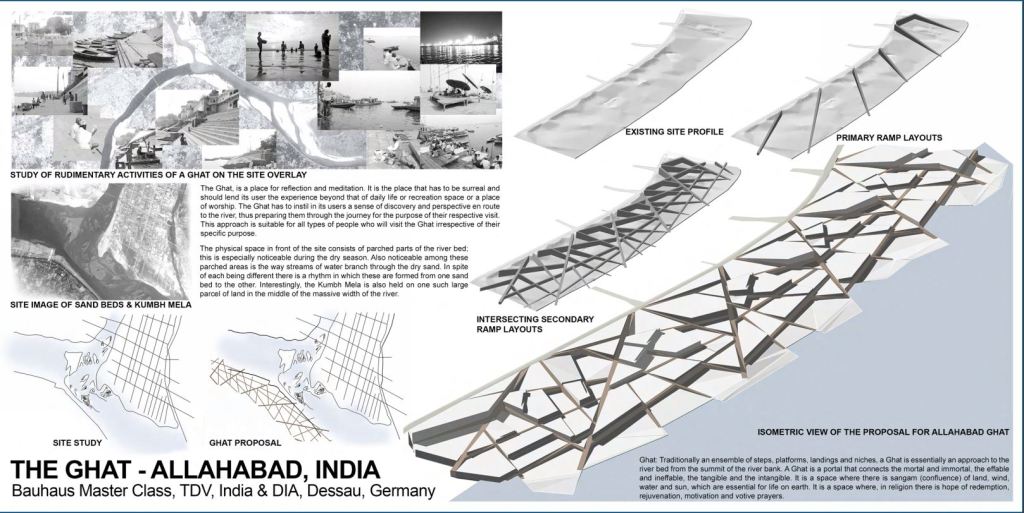
There are two specific contexts which inspire the proposal; one is the metaphysical definition of a Ghat and the other is the physical space around the site.
The Ghat, is a place for reflection and meditation. It is the place that has to be surreal and should lend its user the experience beyond that of daily life or recreation space or a place of worship. The Ghat has to instil in its users a sense of discovery and perspective en route to the river, thus preparing them through the journey for the purpose of their respective visit. This approach is suitable for all types of people who will visit the Ghat irrespective of their specific purpose.
The physical space in front of the site consists of parched parts of the river bed; this is especially noticeable during the dry season. Also noticeable among these parched areas is the way streams of water branch through the dry sand. In spite of each being different there is a rhythm in which these are formed from one sand bed to the other. Interestingly, the Kumbh Mela is also held on one such large parcel of land in the middle of the massive width of the river. This part of the sand bed is very geometrically dissected by a network of routes beside which the camps for the pilgrims are set up. The site which faces these beds is a mirror of the features which are drawn on sand by nature and human beings.
Proposal
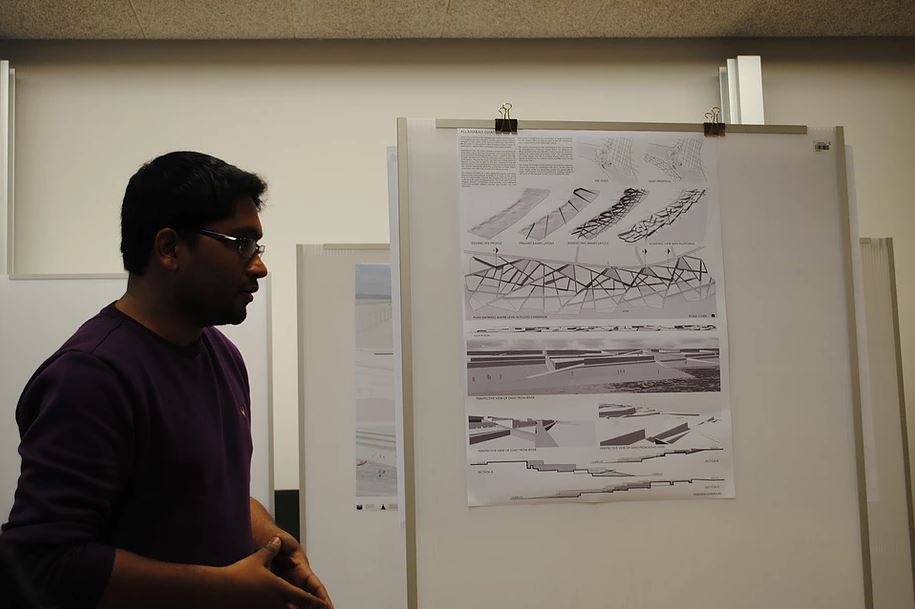
The proposed design of the Ghat veers towards intrigue, interest, connections and activities and looks to facilitate local people, religious people and tourists and their practices.
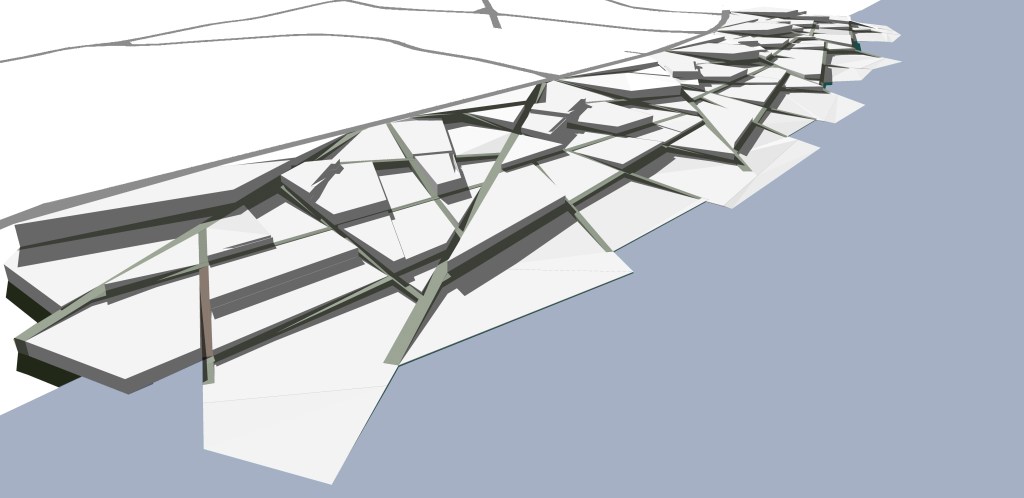
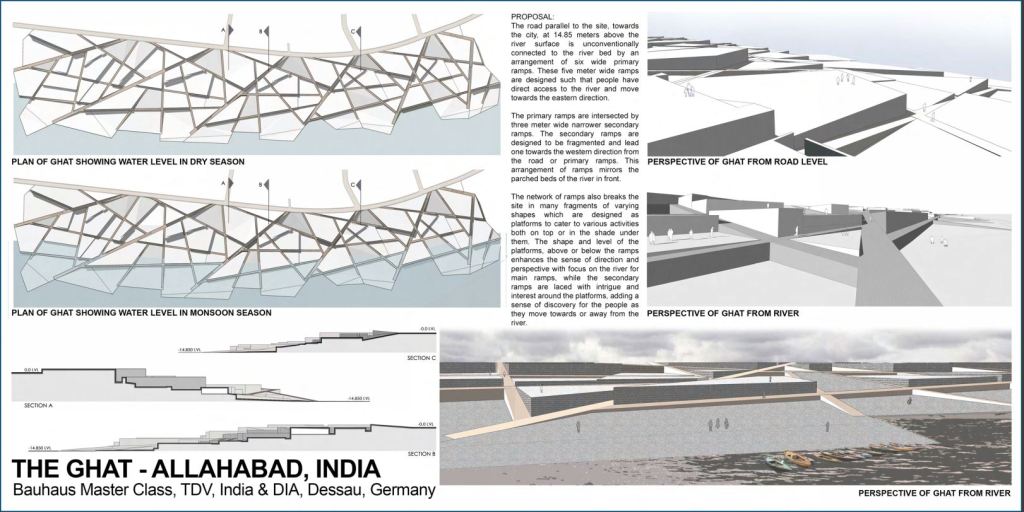
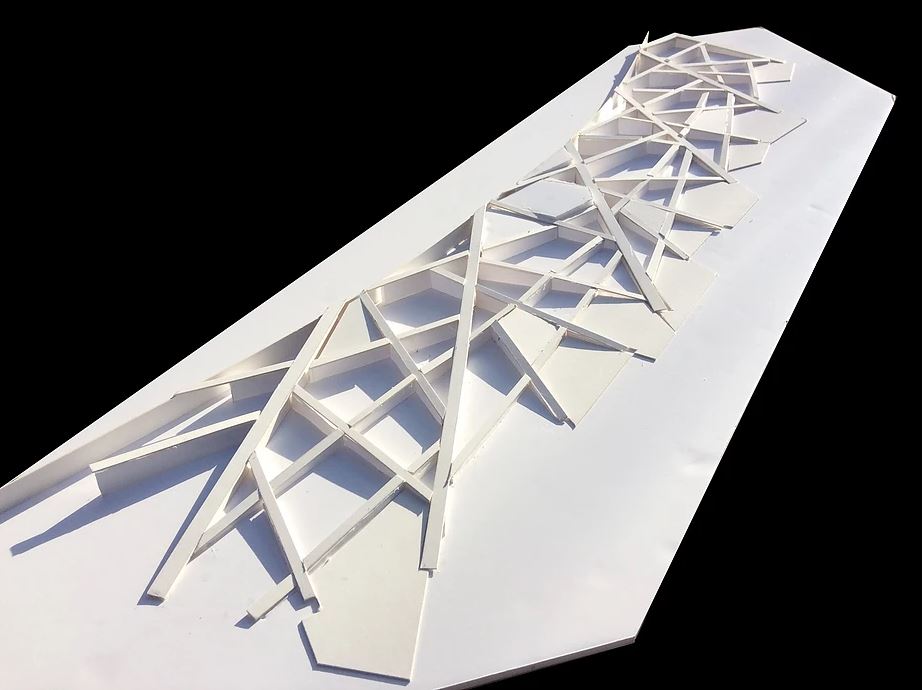
The road parallel to the site, towards the city, at 14.85 meters above the river surface is unconventionally connected to the river bed by an arrangement of six wide primary ramps. These five meter wide ramps are designed such that people have direct access to the river and move towards the eastern direction. These ramps are a mere continuation of the roads leading to the site from the city and divide the site in five relatively equal parts. They are slightly inclined across their width and the lowest end has a water channel, in which a stream of water flows from the main road to the river, accentuating the sense of direction.
The primary ramps are intersected by three meter wide narrower secondary ramps. The secondary ramps are designed to be fragmented and lead one towards the western direction from the road or primary ramps. This arrangement of ramps mirrors the parched beds of the river in front.
The network of ramps also breaks the site in many fragments of varying shapes which are designed as platforms to cater to various activities both on top or in the shade under them. The shape and level of the platforms, above or below the ramps enhances the sense of direction and perspective with focus on the river for main ramps, while the secondary ramps are laced with intrigue and interest around the platforms, adding a sense of discovery for the people as they move towards or away from the river.
The space above or below the platforms can be used for various activities ranging from viewing platforms, landscape, public baths, educational spaces, performance or exhibition spaces, public gathering spaces, religious or meditation spaces, administration or public amenities. The lowest laying platforms touch the water in the dry season and act as traditional Ghats with access to the river. During the monsoon season when the water surface raises these platforms are submerged and the platforms above it start acting as Ghats for those months, thus continuing the intrinsic function of a traditional Ghat as well.
 Architecture, Art & Beyond
Leave a comment